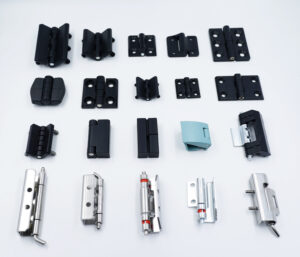
Industrial hinges may look simple, but they are among the most consequential components in any enclosure, cabinet, or access panel system. Choose the wrong hinge, and you’re dealing with misaligned doors, premature wear, or even safety hazards in the field. Choose the right one, and the system runs smoothly for a decade or more.
At HTLOCK, we have been manufacturing industrial hinges for over 24 years — supplying OEMs and distributors across data centers, energy storage, rail transit, heavy trucks, telecom infrastructure, and medical equipment. This guide distills what our engineering team has learned into a practical reference you can use when specifying hinges for your next project.
1. What Are Industrial Hinges?
An industrial hinge is a load-bearing pivot component that connects two objects — typically a door or panel to a frame — while allowing controlled rotation. Unlike consumer-grade door hinges, industrial hinges are engineered for:
- High-cycle durability: Hundreds of thousands of open/close cycles without degradation
- Environmental extremes: Continuous operation in temperatures from −40°C to +120°C, humidity, dust, and chemical exposure
- Precision alignment: Tight tolerances that maintain door seal integrity across the service life
- Application-specific loads: From lightweight access panels to 200+ kg steel enclosure doors
They are essential in any sector where equipment enclosures require secure, reliable, and repetitive access: electrical cabinets, IT racks, vehicle compartments, HVAC units, medical devices, and industrial machinery.
2. Key Functions and Design Principles
The core function of an industrial hinge is to provide smooth, predictable rotation. But modern designs must also satisfy several engineering requirements simultaneously:
- Load distribution: The hinge must transfer door weight and dynamic forces into the frame without concentrated stress points
- Corrosion resistance: Especially critical for outdoor telecom cabinets, marine equipment, and food-processing environments
- Sealing compatibility: The hinge geometry must work with gaskets to maintain IP / NEMA enclosure ratings
- Installation efficiency: Designs that reduce assembly time — weld-on, bolt-on, clip-on — directly lower production costs
- Safety compliance: Self-closing and hold-open features that meet fire-rating and operator-safety standards
A well-designed hinge is never an afterthought. It is an integrated part of the enclosure’s mechanical architecture.
3. Types of Industrial Hinges
Different applications demand fundamentally different hinge mechanisms. Here is the full landscape:
Stainless Steel Hinges
The workhorse of corrosive and hygienic environments. HTLOCK offers both 304 grade (general corrosion resistance) and 316 grade (enhanced chloride resistance for marine and chemical processing). Common in food & pharma equipment, outdoor telecom cabinets, and medical devices.
Torque / Rotational Torque Hinges
Friction-based designs that hold a door or panel at any angle without external stays. Essential for operator-accessed panels that must stay open during maintenance — think EV charging stations and industrial automation enclosures.
Heavy-Duty Hinges
Engineered for steel enclosure doors weighing up to 200+ kg. Available in weld-on and bolt-on configurations, with galvanized or stainless steel finishes. Typical applications: power distribution cabinets, rail transit access panels, and heavy truck compartments.
Concealed Hinges
Fully hidden when the door is closed, providing a clean, tamper-resistant exterior. Used in high-end IT enclosures, architectural panels, and security-sensitive equipment where aesthetics and access control matter.
Removable / Lift-Off Hinges
Allow the door to be lifted off without tools, ideal for equipment requiring frequent internal access or panel removal during maintenance. Common in HVAC units, vending machines, and industrial machinery.
Cold Storage Hinges
Performance-rated for sustained operation down to −40°C. The material and lubricant package is specifically formulated to prevent seizure in sub-zero environments — critical for cold chain logistics and refrigerated transport.
Spring Hinges
Self-closing designs that return the door to a closed position automatically. Used in fire-rated enclosures, safety-critical electrical cabinets, and applications where an inadvertently open door creates a hazard.
Specialty & Custom Hinges
When standard catalog parts do not fit — non-standard mounting patterns, unique rotation angles, integrated locking, or exotic materials — HTLOCK’s engineering team provides full OEM/ODM customization, from 3D-printed prototypes to production tooling.
4. Material Selection Guide
Material choice directly determines corrosion life, load rating, and total cost. Here is how to match material to application:
HTLOCK’s edge: We operate our own die-casting, stamping, and machining workshops in-house, which means we control material quality from raw stock to finished surface treatment — no outsourcing gaps in the quality chain.
5. How to Specify an Industrial Hinge: The 5-Point Checklist
When you sit down to specify a hinge, work through these five parameters in order:
1. Load Capacity
Calculate the total door weight (door panel + any mounted equipment). Then factor in dynamic loads: vibration (vehicle applications), wind (outdoor cabinets), and operator forces. Select a hinge rated at a minimum of 1.5× the calculated static load. For heavy steel doors above 80 kg, always confirm with the manufacturer’s load curve — do not rely on nominal ratings alone.
2. Material & Environment
List every environmental stress the hinge will face: temperature range, humidity, chemical exposure, UV, salt spray, washdown cycles. This narrows the material options immediately. For outdoor equipment in coastal areas, nothing substitutes for 316 stainless steel.
3. Dimensions & Mounting
Measure the available mounting surface area on both door and frame. For retrofit projects, the existing hole pattern dictates the hinge footprint. For new designs, optimize the hinge size to the door — a hinge that is too small creates a stress concentration; one that is too large wastes space and cost. HTLOCK stocks hinges from compact 40 mm designs to extended 150+ mm mounting plates.
4. Rotation Angle
Determine the required opening angle: 90°, 180°, 270°, or full 360°. Also check for any physical obstructions in the swing path (adjacent cabinets, wall proximity, cable bundles). Some torque hinge designs have built-in angle limits that must be specified at the design stage.
5. Cycle Life Expectation
Estimate how many open/close cycles the hinge will see over the equipment’s service life. A data center cabinet door opened twice a day for 10 years is ~7,300 cycles — trivial for any quality hinge. A truck compartment door opened 20 times daily over 15 years is ~110,000 cycles — here, material fatigue and bushing wear become real factors.
6. Common Application Scenarios
Here is how hinge selection typically maps to real-world applications across the industries HTLOCK serves:
7. Why Manufacturing Quality Matters
A hinge’s performance is not just about the design on paper — it is about how it is made. Three manufacturing factors separate a reliable hinge from one that fails in the field:
Material Traceability: Raw material certificates (mill test reports) confirm the actual alloy composition. At HTLOCK, every batch of stainless steel is traceable to the mill, supporting our ISO 9001 quality system.
Precision Machining: Hinge pin-to-knuckle clearance must be held to tight tolerances — too loose and the door sags; too tight and the hinge binds. In-house CNC machining and stamping ensure consistent part-to-part repeatability across production runs of 5,000 or 50,000 units.
Surface Finish Integrity: For plated or coated hinges, the finish is the first line of defense against corrosion. HTLOCK’s in-house polishing and surface treatment lines mean finish quality is controlled end-to-end, with RoHS and REACH compliance verified.
8. Frequently Asked Questions
Q: What is the difference between 304 and 316 stainless steel hinges? 316 contains molybdenum (2–3%), which dramatically improves resistance to chlorides and salt spray. For general indoor/outdoor use, 304 is sufficient. For marine, coastal, or chemical environments, specify 316.
Q: Can HTLOCK produce hinges to custom dimensions? Yes. Custom sizes, materials, torque values, and finishes are standard OEM services. Send us your drawing or specification, and our engineering team will provide a feasibility review, typically within 48 hours.
Q: What is the minimum order quantity (MOQ)? MOQ varies by product and customization level. We support both prototype orders (ideal for design validation) and high-volume production runs. Contact our sales team with your requirements for a specific quotation.
Q: How do I determine the right torque value for a torque hinge? Torque is a function of door weight, center of gravity, and required holding position. Provide your door dimensions and weight, and our engineers can calculate the correct torque specification and recommend the appropriate hinge model.
Q: Do you provide testing and certification documentation? Yes. We supply material certificates, dimensional inspection reports, salt-spray test results (for stainless hinges), and load-test data upon request. Our ISO 9001 certification covers the full manufacturing process.
Q: How long does delivery take? Standard catalog hinges are typically in stock and can ship within 3 working days. Custom orders generally require 15–20 working days from drawing confirmation, depending on tooling requirements.
Conclusion: The Right Hinge Is an Investment, Not an Afterthought
Industrial hinges carry the entire service life of an enclosure — literally. Every open, every close, every vibration, every weather cycle runs through the hinge. Cutting corners on hinge specification saves pennies at the BOM level and costs thousands in field failures, warranty claims, and brand damage.
With 24 years of manufacturing experience, in-house production from die-casting to assembly, and a track record serving global brands like Schneider, Huawei, BYD, ABB, and Siemens, HTLOCK delivers hinges engineered for the real conditions your equipment faces — not just the spec sheet.
Need help specifying a hinge for your application? Contact our engineering team — we will review your requirements and provide a recommendation within one business day.
Ruian Haitan Locks Co., Ltd. | ISO 9001 · RoHS · REACH Certified Specializing in industrial locks, hinges, handles, and access control hardware since 2002 hitanlock.com