Industrial Rod Control Lock Solutions: A Practical Selection Guide
Here’s a problem that shows up in a lot of enclosure projects. You’ve built a cabinet door that’s 1.5 meters tall, the gasket is in place, the door closes, and it still leaks. Or it bows in the middle so the seal only touches at the corners. Or a fork lift panel rattles because the latch holds the door at one point in the center and nothing else.
A single-point cam lock can’t fix that, no matter how good it is. What you need is a rod control lock, also called a multi-point locking system, and this post covers how they work, when they’re worth the extra cost, and what specs actually matter when you order one.
What a rod control lock actually does
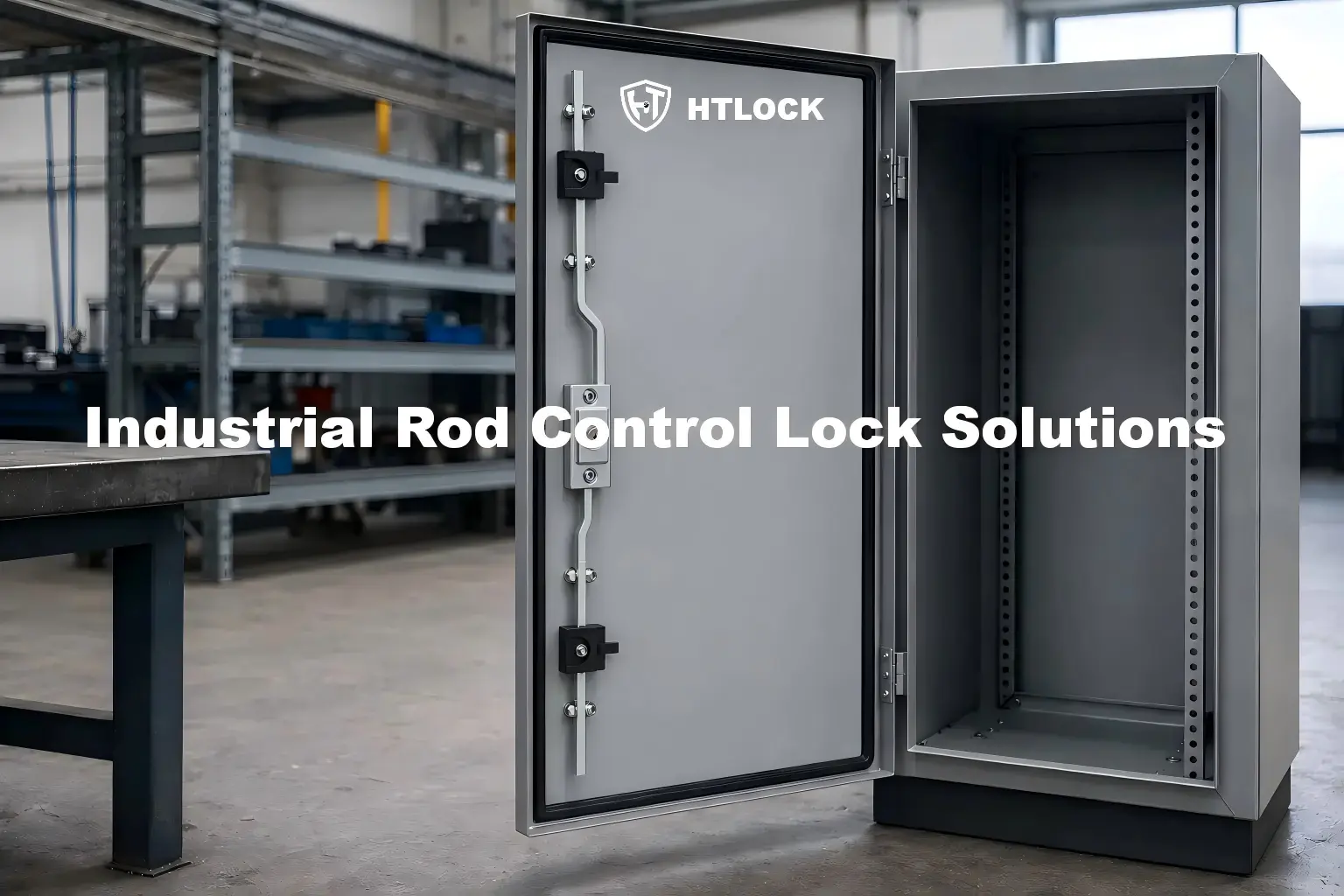
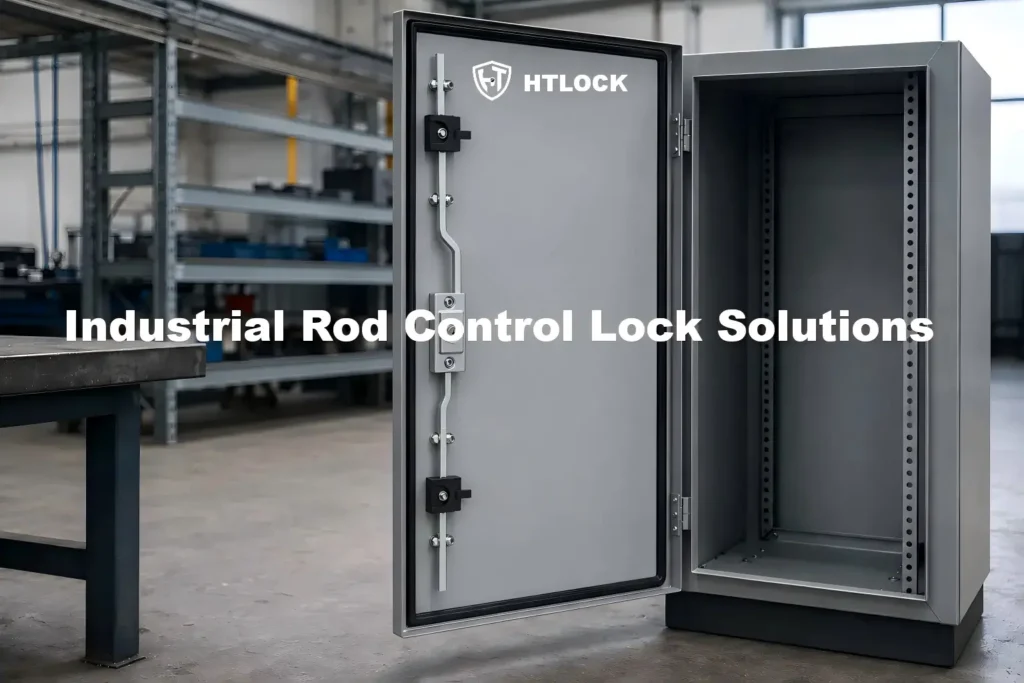
A rod control lock takes one handle movement and distributes it to several locking points around the door. Turn the handle 90 degrees, the drive plate inside the transmission body rotates, and connecting rods push pawls out at two or three positions, typically top, middle, and bottom of the door edge.
That changes the mechanics of the door in a way a single latch can’t. Instead of one point holding the panel, you now have the door pulled against its frame at multiple points, which means the gasket compresses more evenly, the panel deflects less under load, and the door resists prying at the corners where attack usually starts.
We build these under our MS832, MS830, MS861 and MS831 series. They’re used in control boxes, power distribution cabinets, communication cabinets, vehicle doors, and chassis cabinets, which covers most of what an industrial enclosure needs.
When you actually need one
Not every cabinet needs a rod control system, and we’d rather tell you that than sell you one you don’t need. Here’s when the multi-point approach pays off:
Tall or wide doors. Past roughly 800 mm in height, a single center latch starts to lose its grip on the door geometry. The panel flexes, the seal is uneven, and the door can spring open under pressure.
Gasketed or weather-sealed enclosures. If the door carries a compression gasket for IP protection, the seal has to be loaded evenly. One latch point loads one spot. Three points spread that load across the full door edge.
Vibration environments. Vehicle compartments, generator housings, anything mounted on equipment that moves. A door held at three points doesn’t rattle loose the way a single latch can.
Security-driven panels. Multi-point locking means three places to defeat instead of one. It’s a meaningful step up in tamper resistance for outdoor cabinets.
If your door is short, unsealed, and indoors, a standard cam lock is simpler and cheaper, and there’s no reason to complicate it.
The specs that decide whether the system works
This is the part most spec sheets skip, and it’s where projects go wrong. For a rod control lock, the numbers that matter most aren’t the handle. They’re the transmission geometry.
Panel thickness. Our MS832 fits panel thickness from 1.0 mm to 3.0 mm. Get this wrong and the lock either won’t seat or sits proud of the door face.
Spigot height. The MS832’s spigot height is 23 mm. This determines how far the lock body extends behind the panel, which matters on doors with internal insulation or a double wall.
Telescopic distance. The MS832 has 15 mm of telescopic travel. This is the number people overlook. When the gasket compresses, the door moves inward, and the rods have to absorb that movement without binding. If your gasket compresses 8 mm and your lock only travels 5 mm, the mechanism will be under constant load and you’ll see premature wear. Match the telescopic distance to your gasket compression.
Opening direction. Rod positions and pawl directions are handed. The MS832 is available configured for left or right opening. Specify this at the order stage, because it’s not something you can flip in the field.
Rod length. The rods are cut to your door height. This is a custom dimension, so give us the exact door size rather than a nominal one.
Sealing at the transmission. The MS832 uses the transmission body as a drive plate with waterproof sealing. If your cabinet is outdoors or in a washdown area, that sealing detail matters more than the lock’s material. The MS830 takes the other approach with a dust-proof cover.
Materials and finishes, and why they aren’t the same across models
The MS832 body and transmission shell are zinc alloy (ZDC), while the pawl and connecting rod are carbon steel with zinc plating. That combination is deliberate. Zinc alloy die-casting gives you a complex housing geometry at reasonable cost, and carbon steel gives the rods the stiffness they need over a long span. A zinc alloy rod would flex.
The MS861-2E is built differently on purpose. It uses a nylon (PA) housing with a zinc handle, which suits applications where you want a lighter, non-metallic exterior, and it’s operated by key rather than handle. Different door, different mechanism.
For finishes, the MS830 comes in black painted, silver painted, and the two standard cabinet greys, RAL 7032 and 7035. If your cabinet is powder-coated in a specific color, matching the lock to it is a small detail that makes an installation look finished. Custom colors are available through spray coating.
The range, and how to pick between them
MS832. Handle operated, 90 degree rotation, waterproof sealing at the transmission, left or right opening. The general-purpose choice for control boxes, power boxes, and communication cabinets.
MS830. Lift-the-crank style with a dust-proof cover. Available as a standard lock or a padlock-style version, depending on whether you want a keyed cylinder or the ability to use your own padlock. Three-point locking with optional rods and accessories.
MS861-2E. Key-operated, nylon housing with zinc handle, three-point locking. Common on distribution panels and vehicle doors.
MS831-1 and MS831-2. Swing handle multi-point versions, for when the opening action needs to be a swing rather than a lift.
MS830-2G, MS851, MS484. Panel and latch variants in the same family, for 3-point locking on different door constructions.
MS8491. Heavy-duty zinc alloy latch, matte black, for larger panels and tougher environments.
If you’re not sure which fits, send us the door drawing and we’ll tell you, that’s a shorter conversation than reading six datasheets.
Mistakes we see on incoming orders
Three come up often enough to mention.
Rod length quoted from the nominal door size. If your door has a folded lip or a returned edge, the rod has to clear it. Measure the actual travel path, not the door outline.
Gasket compression ignored. Covered above, but it’s the number one cause of a multi-point system feeling stiff or not engaging the last pawl.
Opening direction assumed. Left-hand and right-hand aren’t interchangeable after the fact. Check which side the hinges are on and specify it.
What to send with your inquiry
Six items get you an accurate quote on the first reply:
- Door height and width, plus rod length if you’ve already worked it out.
- Panel thickness (for MS832, the working range is 1.0 to 3.0 mm).
- Gasket compression, if the door is sealed.
- Opening direction, left or right.
- Environment, indoor, outdoor, washdown, vibration.
- Finish requirement, including a RAL number if you need a color match.
We’re a factory in Wenzhou that’s been making cabinet locks and hardware since 2002, so the rods, the pawls and the housings all come out of our own workshops. Send us the drawing and we’ll come back with a spec, a rod length, and a lead time. No request on MOQ, standard lead time runs 7 to 15 days, and samples are free if you cover the courier.